
Botox vs. Dysport: What’s the Difference and Which Is Right for You?
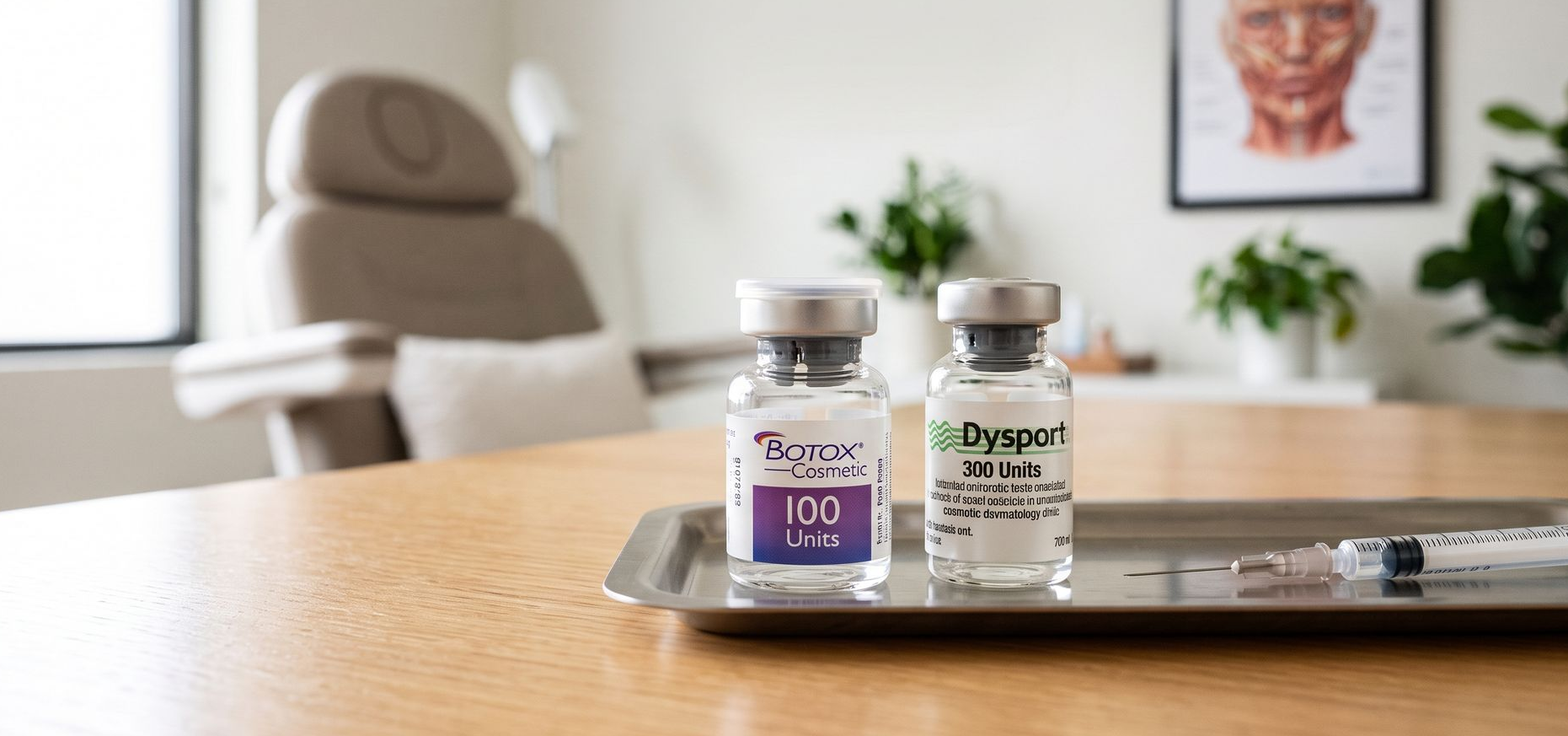
If you're considering an injectable treatment for forehead lines, frown lines, or crow's feet, you've probably encountered two familiar names: Botox® and Dysport®.
Both are popular neurotoxin treatments designed to temporarily reduce muscle activity that contributes to expression lines. While Botox and Dysport work in similar ways, they aren't identical—and one isn't automatically "better" than the other.
At Solara Med Aesthetics in Oceanside, CA, choosing a neurotoxin isn't about following a trend or automatically selecting the product you've heard about most. It's about understanding your facial anatomy, muscle movement, treatment history, and aesthetic goals.
For patients who want to look refreshed without looking frozen or noticeably "done," thoughtful product selection and precise placement matter far more than chasing a particular brand.
How Do Neurotoxins Work?
Many of the lines we notice as we age develop because of repeated facial expressions.
Every time you smile, squint, concentrate, or raise your eyebrows, facial muscles contract and cause the overlying skin to fold. When we're younger, the skin generally returns to its resting position easily. As collagen and elasticity decrease with age, those repeated folds can become increasingly visible even when the face is relaxed.
Neurotoxins temporarily reduce communication between targeted nerves and muscles. When carefully injected into specific facial muscles, they reduce excessive contraction and allow the overlying skin to appear smoother.
Common treatment areas include:
- Forehead lines
- Frown lines between the eyebrows
- Crow's feet
- Certain lines around the nose
- Selected lower-face concerns
- Other areas where muscle activity affects facial appearance
The objective at Solara Med Aesthetics isn't to eliminate expression. It's to strategically soften movement while maintaining a natural, balanced appearance.
What Is Botox?
Botox® Cosmetic is an injectable neurotoxin containing onabotulinumtoxinA.
It has been widely used in aesthetic medicine to temporarily improve the appearance of certain facial lines caused by muscle movement.
Because Botox has become such a recognizable name, people sometimes use "Botox" as a general term for neurotoxin treatments. However, Botox is a specific brand, just as Dysport is.
Treatment is generally quick, with a series of small injections placed according to your facial anatomy and desired outcome.
Results aren't immediate. Changes typically begin appearing within several days and continue developing afterward.
What Is Dysport?
Dysport® is another injectable neurotoxin used to temporarily improve certain expression-related facial lines.
Its active ingredient is abobotulinumtoxinA.
Like Botox, Dysport works by temporarily reducing targeted muscle activity. The formulation and dosing characteristics differ, however, which means Botox units and Dysport units aren't interchangeable.
Some patients develop preferences based on their previous experiences, while others may respond particularly well to one formulation. Your provider can help determine which option makes the most sense based on your anatomy, treatment area, history, and goals.
Botox vs. Dysport: What's the Main Difference?
The biggest misconception is that choosing between Botox and Dysport is simply about deciding which product is "stronger."
A better question is: Which treatment strategy is most appropriate for your face?
Both products can create beautiful results when appropriately selected and administered.
Differences can include formulation, dosing, diffusion characteristics, onset, and individual patient response. These distinctions may influence which product your provider recommends for a particular treatment area.
But the injector matters enormously.
Even an excellent product can produce an undesirable outcome if too much is used, injections aren't appropriately placed, or treatment doesn't account for the patient's natural expressions and facial proportions.
Can Botox or Dysport Look Natural?
Absolutely.
Natural-looking neurotoxin treatment depends heavily on dosage, placement, anatomy, and the desired result.
At Solara Med Aesthetics, our philosophy isn't to remove every line or stop every facial expression. Instead, treatment is designed to soften distracting lines while helping preserve the characteristics that make your face uniquely yours.
This is especially important for patients in their late 30s and 40s who may want to address developing signs of aging without dramatically changing their appearance.
The ideal compliment after treatment isn't necessarily, "Your Botox looks great."
It's often simply, "You look refreshed."
What Is Preventative Botox?
Preventative neurotoxin treatment refers to using Botox, Dysport, or another appropriate neurotoxin before expression lines become deeply established.
Imagine repeatedly folding the same piece of paper. Eventually, a crease develops.
Skin can behave similarly. Years of repeated muscle contractions can contribute to increasingly visible expression lines.
Reducing excessive movement in selected muscles may help slow the development or deepening of some expression lines.
That doesn't mean everyone needs to begin Botox at a particular age. There is no universal "right age."
Some people develop noticeable expression lines in their 20s, while others don't become concerned about them until their 40s or later.
Treatment should be based on your anatomy and goals—not your birthday.
How Long Do Botox and Dysport Last?
Results vary from person to person.
Factors that can influence longevity include:
- Individual metabolism
- Muscle strength
- Treatment area
- Dose
- Previous treatment history
- Physical activity
- Individual response to the product
Neurotoxin results commonly last several months, after which muscle movement gradually returns.
A personalized maintenance schedule can help maintain results without unnecessarily overtreating the face.
Does Neurotoxin Treatment Hurt?
Treatment is generally quick and well tolerated.
A very fine needle is used to administer small injections into targeted muscles. Patients commonly describe the sensation as a brief pinch.
An appointment itself may take less than 30 minutes depending on the number of areas being treated, making neurotoxins a convenient option for patients with busy schedules.
Is There Downtime?
Neurotoxin treatments generally require little downtime.
Temporary redness, tenderness, swelling, or bruising around an injection site can occur. Your provider will give you appropriate aftercare instructions and explain what to avoid following treatment.
As with any medical aesthetic procedure, side effects and complications are possible. A consultation with a qualified medical professional is essential to determine whether treatment is appropriate for you.
Which Is Better: Botox or Dysport?
Neither product is universally better.
The best choice depends on you.
Your facial anatomy, muscle strength, areas of concern, previous neurotoxin experience, and desired degree of movement should all be considered.
That's why Solara Med Aesthetics takes a personalized approach instead of treating every patient with the same dose, injection pattern, or product.
With more than 20 years of combined nursing experience, Bevin Mowbray, RN approaches aesthetic treatment with an emphasis on precision, restraint, facial harmony, and natural-looking results.
Frequently Asked Questions About Botox vs. Dysport
Will Botox or Dysport make my face look frozen?
The goal of carefully planned treatment is to soften unwanted muscle activity while maintaining appropriate facial expression. Results depend on dosage, placement, anatomy, and your treatment goals.
Which treatment works faster?
Onset varies between products and between patients. Some people report noticing changes sooner with one formulation, but individual response differs. Your final result should be evaluated after the appropriate treatment period recommended by your provider.
Can I switch from Botox to Dysport?
Potentially. Patients sometimes try different neurotoxins based on their response or provider recommendation. Your treatment history should be discussed during your consultation.
How do I know how many units I need?
There is no ideal number of units for everyone. Muscle strength, anatomy, treatment area, desired movement, and the specific product being used all influence dosing.
Can neurotoxins be combined with other treatments?
Yes, when medically appropriate. Neurotoxins may be incorporated into a broader rejuvenation plan alongside treatments such as dermal fillers, SkinPen™ Microneedling, PRP, PRF, Sculptra®, or other collagen-focused treatments.
Find Botox and Dysport in Oceanside, CA
The difference between a generic injectable appointment and a personalized aesthetic experience begins with the treatment plan.
At Solara Med Aesthetics, we focus on helping patients age gracefully through thoughtful treatments that respect facial anatomy and preserve natural expression.
If you're considering Botox or Dysport in Oceanside, schedule a consultation to discuss your concerns and determine which neurotoxin may be best suited to your goals.
Solara Med Aesthetics is located at 4161 Oceanside Boulevard, Suite 101 – Studio 19, Oceanside, CA 92056, and welcomes patients from Carlsbad, Vista, Encinitas, San Marcos, Escondido, and surrounding North County San Diego communities.
Suggested Internal Links: Botox / Neurotoxins | Dermal Fillers | About Bevin | Contact / Book Appointment
Medical Disclaimer: This article is provided for general educational purposes only and is not a substitute for individualized medical advice, diagnosis, or treatment. Results, risks, and treatment recommendations vary by patient. Consult a qualified healthcare professional to determine whether neurotoxin treatment is appropriate for you.